


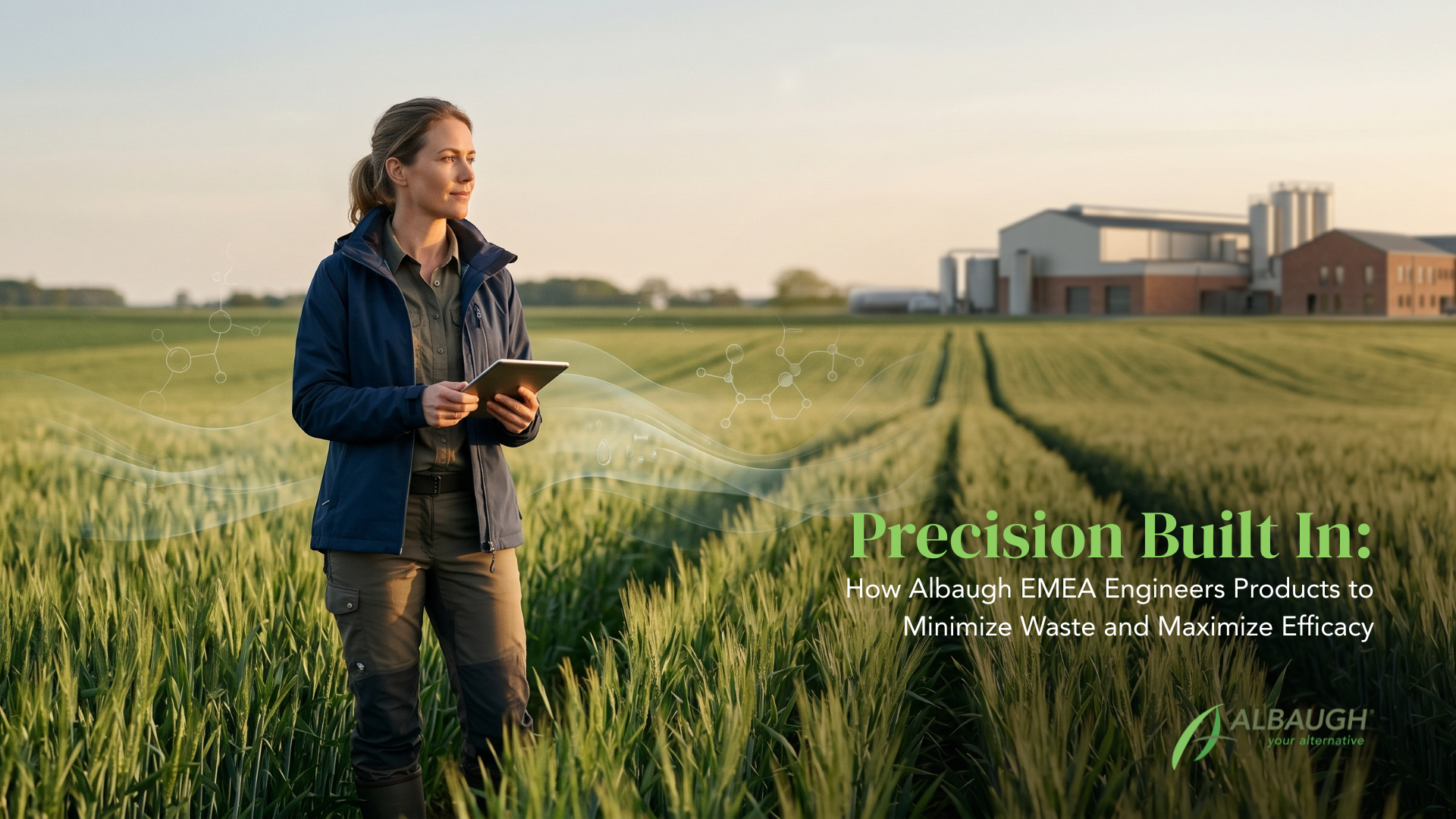
In the modern crop protection industry, precision is no longer a theoretical advantage, but a measurable requirement. With increasing regulatory expectations, rising input costs, and the need for more efficient and sustainable production systems, growers depend on crop protection solutions that perform consistently and predictably. Reliability now extends beyond product labels: it includes formulation science, technical support, and the operational infrastructure behind every bottle. This is where Albaugh distinguishes itself. The organization’s approach to engineering, manufacturing, and technical partnership ensures that precision is not an add-on. It is embedded into the entire process.
EU-Based Crop Protection Manufacturing: Local Production, Measurable Precision
Albaugh’s precision philosophy begins with proximity. By producing approximately 95% of its EMEA portfolio within the European Union (EU), Albaugh aligns its manufacturing environment directly with the agricultural conditions, regulatory standards, and performance expectations of EMEA growers.
Local production delivers several measurable advantages:
- Tighter quality control: EMEA-based facilities operate under strict regulatory and manufacturing protocols, ensuring consistency across every batch.
- Faster response time: Being geographically close to customers allows Albaugh to adjust production and supply based on real-time demand, seasonal shifts, and emerging agronomic needs.
- Reduced logistical variability: Shorter supply chains minimize transport-related risks that can compromise sensitive formulations, from temperature fluctuations to extended storage durations.
- Cost efficiency through proximity: With fewer logistical steps and shorter transport distances, Albaugh reduces unnecessary costs, enabling growers to access precise, high-performing solutions without inflated pricing.
Producing within EMEA also enables Albaugh to gather rapid feedback from local agronomists, distributors, and growers. This creates a continuous improvement cycle in which field experience directly informs formulation decisions, ultimately enhancing product accuracy and performance.
Technical Partnership in Crop Protection: More Than a Supplier
Precision does not end at manufacturing. It continues into how products are deployed in the field. Albaugh EMEA’s commitment to being a technical partner, and not just a supplier of crop protection solutions, is central to making every application more accurate and effective.
Albaugh invests heavily in:
- Field trials across diverse conditions to ensure formulations work consistently on different soils, crops, climates, and water qualities.
- Technical support for advisors and distributors, enabling correct product positioning, dosage accuracy, and application optimization.
- Collaborative problem-solving, where insights from growers directly inform product refinement.
This deep technical engagement allows Albaugh to engineer solutions based on actual field complexity rather than theoretical performance. The result is more dependable behavior during application: predictable droplet formation, consistent adhesion and spreading, stable mixing properties, and reliable interaction with local water chemistry.
By positioning itself as a technical partner, Albaugh bridges the gap between formulation science and real-world performance, which is a key differentiator from generic suppliers who focus primarily on basic product availability.
Formulation Science and Waste Reduction: How Albaugh Engineers for Efficiency
Albaugh’s emphasis on formulation quality is grounded in measurable outcomes: improving active ingredient delivery, reducing drift and evaporation losses, enhancing tank mix stability, and ensuring uniform coverage. Each formulation goes through a rigorous engineering process that includes:
- Physical and chemical stability testing to prevent sedimentation, phase separation, and viscosity issues.
- Droplet spectrum analysis to optimize droplet size distribution and reduce drift.
- Cold and heat storage tests to ensure durability across varying transport and storage conditions.
- Compatibility studies to confirm stable tank-mixing with commonly used products.
- Application simulations to evaluate spreading, adhesion, rainfastness, and surface activity on target crops.
These processes ensure that every component of a formulation contributes to delivering the intended agronomic effect with minimal waste.
This engineering discipline results in:
- Higher retention of active ingredients on plant surfaces
- More consistent biological performance
- Reduced need for reapplication
- Better use efficiency per hectare
Precision, in Albaugh’s context, means maximizing results from every liter applied and minimizing losses throughout the application process.
Why Precision Crop Protection Matters for EMEA Growers
As the agricultural and crop protection landscapes face increasing pressure due to climate variability, sustainability demands, and regulatory intensification, precision becomes essential to achieving both productivity and compliance.
Albaugh’s approach integrates three pillars:
- Local, EU-based manufacturing, delivering consistency, responsiveness, and cost efficiency.
- Technical partnership, ensuring that solutions are field-validated, application-optimized, and supported with expert guidance.
- Engineering-driven formulation science, minimizing waste and maximizing the biological performance of every input.
Together, these form a precision ecosystem that supports growers in achieving more predictable outcomes, more efficient operations, and better return on investment.
Albaugh is not positioning itself simply as a generic alternative. It is positioning itself as the precise alternative, a company that delivers accuracy at every stage, from formulation to field.
Because in today’s agricultural environment, precision is not simply beneficial. It is essential to performance, sustainability, and ultimately, profitability.
